|
Home Intro Technical History Crew Models Gallery Kriegsmarine Archives
More Forum  UPDATES UPDATES |
BISMARCK PROTECTION
Updated 01 July 2019
Battleships had to be able to withstand repeated hits and continue fighting, so their armour expanse, distribution, and thickness were extremely important.
In terms of expanse, the Bismarck devoted 19,082 mt to belt, deck, turret, underwater, and splinter armour, which amounted to about 40% of its designed combat weight (47,870 mt).
Only the 69,100 mt Japanese battleships of the Yamato class carried more armour (22,895 mt), although at a much smaller percentage (33.2%) of the ship's total weight.
The steels used to build the Bismarck were the end result of extensive research and development that began shortly after the First World War ended.
This led to the creation of armour and construction steel that was clearly superior to previous materials.
In terms of specifics, the following criteria apply:
KC n/A (Krupp Cemented, new type). Face-hardened armour steel.
This material contained 3.5-3.8% nickel, 2% chrome, 0.3% carbon, 0.3% manganese, and 0.2% molybdenum, and it was used for the side belt, turrets, barbettes, and conning towers.
The 670 Brinell face-layer tapered in hardness as it extended into 40-50% of the plate's total thickness.
Post WWII proving ground test indicated that KC was only slightly less resistant than British cemented armour (CA), and markedly superior to US Class A plates.
Wh n/A (Wotan hart, new type). Homogeneous armour steel with a tensile strength of 85-95 kg/mm², a strain of 20% and a yield point of 50-55 kg/mm².
This material was used for the armoured decks, and, in the thickness employed aboard the Bismarck, was the equal of most foreign homogeneous plates.
Ww n/A (Wotan weich, new type). Homogeneous armour steel with a tensile strength of 65-75 kg/mm², a strain of 25% and a yield point of 38-40 kg/mm².
This material was used for the longitudinal torpedo bulkheads.
Materials Employed.
St 52 KM. Construction grade steel with a tensile strength of 52-64 kg/mm², a strain of 21% and a yield point of 36-38 kg/mm².
This material was used for plates with a minimum thickness of 4 mm. Thinner surfaces used St 42 KM.
Vertical Protection.
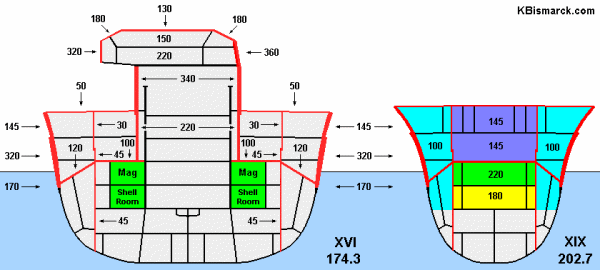
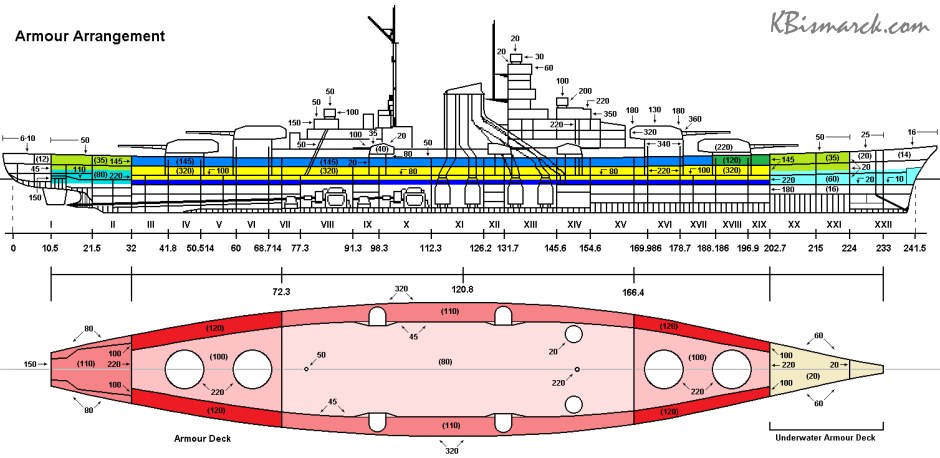
The external armoured citadel included a main KC vertical belt that was 320 mm thick, 4.8 metres wide, and 170.7 metres long. It covered 70% of the waterline from frame 32 to frame 202.7 (by far the greatest extent of any modern battleship), and protected the armour deck, the upper platform deck, and part of the middle platform deck. The belt was backed with a 50 mm thick layer of teakwood that helped absorb shock damage, and it was bolted onto 16-25 mm thick side plating. The majority of the belt was located above the waterline (3.3/1.5 metres as designed, but 2.6/2.2 metres in practice), with the obvious reasoning that shells are more likely to hit above than below the waterline. The citadel area above the main belt was armoured with 145 mm thick KC plates that protected the battery deck all the way to the armoured upper deck. Between frames 186.7 and 202.7 the thickness of this upper belt was 120 mm. This plating could also provide a protected waterplane area in the event of severe lists, decap and slow heavy APC shells, and stop light shells outright. Finally, lighter plating was mounted well forward and aft of the main belt (60 mm Wh forward and 80 mm Wh aft), and this protected nearly the entire waterplane area from splinter of light shell damage.
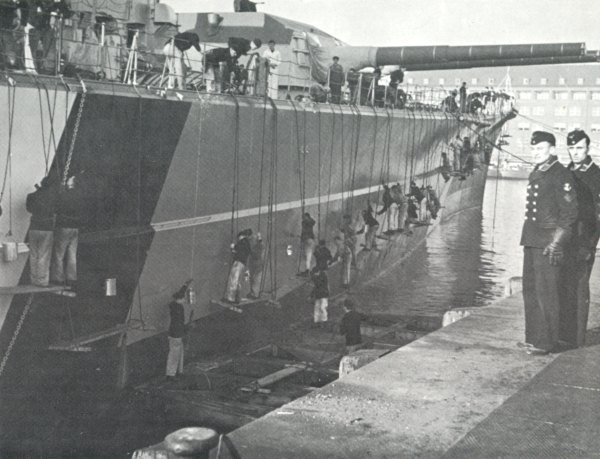
Kiel, March 1941. The 32cm lower main belt which covered 70% of the ship's waterline length, can be clearly seen here.
The belt armour was also inclined outward because of the curvature of the hull in regions forward, abeam, and aft of the main turrets and their magazines, increasing the resistance of the cambered sections that represented around 40% of the main belt's length. The outboard inclination was 17º, 10º, 7º, and 8-10º abreast turrets Anton, Bruno, Dora, and Cäsar respectively. This afforded additional protection while not compromising stability by compressing the bulk of the waterplane area inboard, and especially in the critical amidships area.
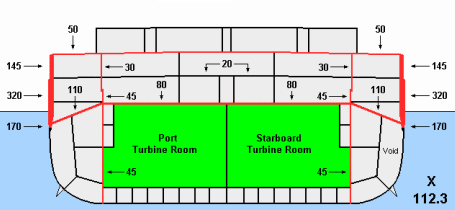
The hull was divided into transverse sections by 22 bulkheads that varied in thickness. An armoured KC bulkhead was located in front of turret "Anton" at frame 202.7, and it marked the citadel's forward limit. This bulkhead extended from the upper deck down to the middle platform deck, and varied in thickness as it descended (145 mm at the level of the battery and armour decks, 220 mm thick at the upper platform deck, and 180 mm at the middle platform deck). It was partially shielded by the ship's 60 mm forward plating, which presented very poor attack angles to shells being fired from the bow quarters. Aft of turret "Dora", at frame 32, there was another armoured transverse bulkhead of similar characteristics, and this was reinforced by the stern's 80 mm thick splinter plating. These two transverse bulkheads, together with the longitudinal side belt and armoured upper deck, defined the external citadel (armour box) which protected the ship outboard areas. The internal raft accorded additional protection to the vitals, as we shall see when examining the horizontal protection scheme.
Horizontal Protection.
The upper deck was 50-80 mm (Wh) thick for most of the ship's length from frame 10.5 to 224. It was planked with 68 mm thick teakwood. The 80 mm platting was located in the area around the secondary turrets.1) A lightly protected 6-20 mm (St 52) thick battery deck was located 2.4 metres beneath the upper deck. The third armour deck was 10.3 metres above the keel, and featured the classic "turtle deck" arrangement with sloped edges. The amidships flat portion of the main armour deck marked the top of the internal armoured raft, and it was situated one metre above the designed waterline. It was 80 mm thick over the machinery spaces and 100 mm over the magazines. The outboard sloped portion of this deck was 110-120 mm (Wh) thick, and inclined downward at about 22º from the horizontal to where it met the lower edge of the main armour belt under the waterline. The armour deck's slopes presented attacking shells that penetrated the side armour with impact obliquities of up to 68º, and were 110 mm thick around the machinery and 120 mm thick adjacent to the magazines. Subsequent analysis indicated that the combined external citadel and internal raft could provide the vitals with relative immunity from 406 mm/45 APC shells fired at point-blank range.
The bow region from frame 202.7 to frame 233 was protected by the 20-mm thick upper platform deck, and the stern had an armoured turtle deck of 110 mm which protected the steering gear.
Horizontal Deck Protection
| Upper deck: | 50 mm (Wh) | 50-80 mm (Wh) | 25-50 mm (Wh) | 50 mm (Wh) |
| Battery deck: | 6-20 mm (St 52) | 6-20 mm (St 52) | 6-12 mm (St 52) | 6-12 mm (St 52) |
| Armour deck (centre-slopes): |
80-110 mm (Wh) | 100-120 mm (Wh) | - | 110 mm (Wh) |
| Upper platform deck: |
- | - | 20 mm (Wh) | - |
| Total (centre-slopes): | 130-160 mm (Wh) | 150-200 mm (Wh) | 45-70 mm (Wh) | 160 mm (Wh) |
Turret Protection.
The main battery turrets were 130-360 mm KC. The barbettes were 340 mm KC over the upper deck, and 220 mm KC thick below it down to the third armour deck. The thickness was reduced because of the additional protection provided by the 50 mm (Wh) upper deck and the 145 mm upper citadel plating. In terms of US Class A armour, the effective resistance of the 340 mm barbette armour was 390-405 mm.

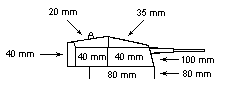
The secondary battery turrets were protected by 20-100 mm Wh plates. Their barbettes were 80 mm Wh above the upper deck. Below the upper deck the barbette armour was reduced to 20 mm since this area was already protected by the 80 mm thick upper deck and the 145 mm thick citadel armour. Moreover, the secondary turrets' ammunition trunks were protected by the main side belt as they descended, and thus there was no need to extend their heavy barbette armour downward.
Command posts. Conning towers.
The forward conning tower had 350 mm KC walls and a 220 mm KC roof. The rangefinder cupola, on top of the conning tower, had 200 mm KC walls and a 100 mm KC roof. The conning tower was connected with the armour deck by a communications shaft of 85 cm in diameter and 220 mm KC walls.
The after conning tower was not so heavily protected. Its sides were 150 mm KC, the roof was 50 mm KC, and the communications shaft running to the lower decks was 70 cm in diameter and 50 mm KC thick. The aft range finder cupola had 100 mm KC walls, and a roof of 50 mm KC.
The foretop command post was lightly protected because it was so high in the foremast that heavy armour would cause stability problems. The walls were 60 mm KC and the roof was 20 mm KC. The cupola's walls were 30 mm KC, and the roof was 20 mm KC.
| Walls | |||
| Roof | |||
| Floor |
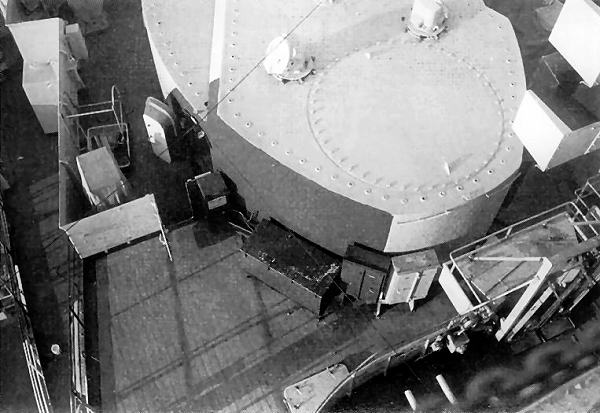
The forward conning tower as seen from the searchlight platform. Its walls were 350 mm thick and the roof 220 mm. The range finder cupola has not yet been installed.
Underwater protection and compartmentation.
Of the hull's 22 watertight sections, 17 were located within the citadel (sections III-XIX). The area above the waterline between the armour and upper deck was divided into three large spaces by 30-mm (Wh) thick port and starboard longitudinal splinter bulkheads. These were located 3-5.4 metres inboard of the side belt, and formed 51 armoured cells within the upper citadel by being transepted by transverse bulkheads. This entire array was divided in the horizontal plane by the intervening battery deck, which resulted in 102 cells. Many of these cells were subdivided by transverse and longitudinal bulkheads, with the compartmentation between the main and battery deck being in the region of 100, and above that number if one includes the compartments fore and aft of the citadel. However, the compartmentation above the armour deck far exceeded that below it.
The underwater hull formed the vast bulk of the internal armoured raft, and it was protected from torpedo and mine damage by 45 mm Ww port and starboard longitudinal bulkheads. These bulkheads were vertical instead of sloped as in the Scharnhorst Class, and could interact with the sloped armour deck above them to increase the vitals' protection against shells, although their main purpose was of course to limit underwater damage.
The distance between the torpedo bulkhead and the outer hull was 5.4 metres amidships, although it tapered to about 3 metres abeam turrets Anton and Dora. German design philosophy attempted to avoid overly wide torpedo protection systems on the grounds that they placed a great burden on stability when flooded. Indeed, the effects of outboard flooding increase as a function of the square of a given water mass's distance from the centreline. A traditional gas expansion/counterflooding space was placed outboard of three liquid-loaded compartments which abutted the main torpedo bulkhead. The fuel oil and feed water these compartments contained, helped slow fragments as well as disperse and absorb the shock waves generated by underwater blasts. The outer void was used for counterflooding. Overall, the torpedo defence system was designed to resist a TNT charge of 250 kg (550 lbs) although its resistance actually proved to be considerably higher than that.2)
The compartmentation within each level of the internal raft was very extensive. There were 3-4 decks above the compartmented double bottom, and each of these was intricately subdivided. For example, the upper platform deck included over 250 compartments, while the middle platform deck had a nearly equal number. The lower platform deck was subdivided into over 200 compartments, and the fuel, potable water, and void spaces below this were even more finely divided. In fact, the double bottom had a depth of 1.7 metres between frames 77.3-154.6, and this provided some protection against underwater explosions from mines.
Finally, the hull was equipped with the MES (Magnetischer Eigenschutz) "magnetic self-protection system". This consisted of a series of cables that demagnetised the ship's hull in defence against magnetic mines and torpedoes.
bulkhead and outer hull |
||
| Turret A (frame 192.55) | 3 meters | 45 mm (Ww) |
| Turret B (frame 174.35) | 3.5 meters | 45 mm (Ww) |
| Midship section (frame 120.8) | 5.4 meters | 45 mm (Ww) |
| Turret C (frame 64.35) | 3.8 meters | 45 mm (Ww) |
| Turret D (frame 46.15) | 3 meters | 45 mm (Ww) |
1) Some sources extend the 80 mm areas from forward to aft of each pair of main turrets, and under the control tower as well.
2) According to “Technical Report No. 222-45. Loss of the Battleship Tirpitz on 12 November 1944”, the torpedo defence system on Tirpitz was designed to withstand about 660 pounds (300 kg) of German hexanite.

| Home Guestbook Quiz Glossary Help us Weights & Measures Video Credits Links Contact |